post

A Simple Way to Write Fresh Songs on Any Stale Topic

I hear songwriters say often: “There are no new songs to write.” Certain topics do come up again and again in song lyrics–romantic love and breakups are especially well-worn.

That doesn’t mean these subjects are sucked dry, though. There’s a simple way to approach a well-worn topic from a new angle:

[Read more...]

link

There’s a live online tribute concert to the late John Braheny tonight, Sunday May 5th at 6pm (PDT) 9pm (EDT).

John was a knowledgeable and generous mentor to hundreds of songwriters. He was a true music lover and an open-minded listener who built his life’s work around the craft of songwriting. I knew John through his excellent book The Craft and Business of Songwriting, which has been a mainstay on my shelf for years.

The broadcast page for the Braheny tribute is here. I’ll be tuning in, and I hope you will too.

post

How to Disappoint Your Audience (in the Best Possible Way)

When writing lyrics, you want your listener to feel something. But unfortunately for us, a lyric as simple as “I'm disappointed and sad, you guys” won't move an audience.

Too bad—that'd make our jobs much easier, eh?

[Read more...]

post

An Easy Way to Write a New Song Lyric Tonight (Even if You’ve Got Writer’s Block)

“How, as a human being, does one face infinity? Through lists, through catalogs, through collections in museums, through encyclopedias and dictionaries…” –Umberto Eco
post

33 Ways to Make More Time in Your Life For Music-Making

1. Disconnect. Power down your computer–or if you absolutely need the thing for some reason related to your practice and studies, sever it from the internet by disabling wireless.

2. Banish Television. According to Nielsen, the average American watches thirty-four hours of television per week (figures in your country are likely similar). Thirty-four hours of television! You know how much time top-shelf violinists spend practicing each week? About twenty-seven hours.

3. Timer. Every day, set a timer for 5-10 minutes. Within that time, work on a particularly mundane task related to your instrument or music theory. This is perfect for memorizing dry material inside and out over a long period of time, in small daily installments.

[Read more...]

post

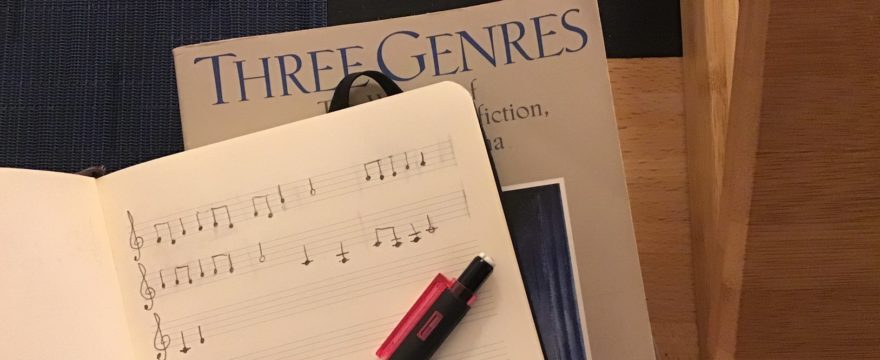
Unravel the Methods of Master Lyricists with an Ordinary Notebook

photo of my cassette tape notebook

Becoming a master lyricist takes years, even decades of study and practice. But the good news is: you can get a meaningful start today. If you've got a little free time, you can start now.

[Read more...]

post

About your music

Your music is not for everyone. That’s a good thing.
[Read more...]

post

Maybe We Only Have to Hear You Once

2893549851_ef5121f78bLicense Some rights reserved by andrechinn

Do you want us to listen to your songs over and over?

Are you sure?

This bit of radio wisdom–that heavy rotation is better–is something we often take for granted. And of course it’s really taken for granted by the high-rolling music industry. “It’s gotta be catchy, it’s gotta have a memorable, addictive hook you want to hear again and again. The more requests the radio stations get, the better. The more YouTube plays it gets, the better. The more sales it makes, the better.”

That’s one perfectly valid way to think about your music. But it’s not the only way, and it’s not the only way to measure success.

[Read more...]

post

Where the Concept of Bridge Sections Came From–and What That Might Mean for the Future of Songwriting


0c740261b4946b89deeec0d579b89fe2

In the 1800's, the music industry moneymaker was sheet music. If you wanted to hear a particular song, you'd wander to the store, buy a book of sheet music, and someone in your family would play that song at the piano. Everybody sing!

Then, about a century ago now, the music recording industry was born. Wax cylinders and records came first. For the first time in history–for the first time out of thousands and thousands of years of human history–it became possible to hear a concert in your home without actually attending the concert in person.

This was a completely new, even futuristic concept at the time–an artist could be recorded once, and then copies of the recorded performance could be sold over and over. Suddenly Louis Armstrong could perform in your living room at the drop of a needle.

That seems like a long time ago now that vinyl records emerged, but in reality it might as well have been yesterday. Radio is less than a hundred years old. Music itself, on the other hand, stretches back to the beginning of human history.

[Read more...]

post

Want Faster Progress? Practice Slowly.

In the long run, going slowly is the fastest way to learn.

Thoroughly absorbing complex songs, music theory concepts, songwriting tactics, and instrumental techniques—all of this takes time. True mastery requires that we go slowly, pay careful attention to our mistakes, and really lock the material into memory.

In the short term, though, that's not always easy. Boredom, frustration, and impatience come wriggling out of the piano to lead us astray. It's always tempting to hurry. [Read more...]